Disclaimer
All content provided on this blog is representation of the blog owner and not Franciscan University of Steubenville. The information on this site is purely used for education purpose. The owner of this blog makes no representations as to the accuracy or completeness of any information on this site or found by following any link on this site. The owner will not be liable for any errors or omissions in this information nor for the availability of this information. The owner will not be liable for any losses, injuries, or damages from the display or use of this information.
Privacy
The owner of this blog does not share personal information with third-parties nor does the owner store information is collected about your visit for use other than to analyze content performance through the use of cookies, which you can turn off at anytime by modifying your Internet browser’s settings. The owner is not responsible for the republishing of the content found on this blog on other Web sites or media without permission.
Blog Comments
The owner of this blog reserves the right to edit or delete any comments submitted to this blog without notice due to;
1. Comments deemed to be spam or questionable spam
2. Comments including profanity
3. Comments containing language or concepts that could be deemed offensive
4. Comments that attack a person individually
This policy is subject to change at anytime.

Friday, November 22, 2013

Urea Hydrolysis Test

For the Urea Hydrolysis test, we can determine the ability of our bacteria to hydrolyze urea.

We obtained a urea medium tube and used the aseptic technique to inoculate the urea medium tube with a loopful of bacteria from our agar slant culture


We then incubated the inoculated tube at 35 degrees Celsius for about two days.

Upon reviewing the results we found out that our bacteria did not utilize urea. 
Urea is excreted in urine to eliminate excess nitrogen from the body. Bacteria who do utilize it contain the enzyme urease to quickly degrade urea into carbon dioxide and ammonia. The presence of the carbon dioxide and ammonia make the medium more alkaline, causing it to turn more red. 
Since our's had no appearance of reddish or pinkish color we could determine that it does not utilize urea.  

Citrate Utilization Test

The Citrate Utilization test determines if our bacteria can utilize citrate as its sole source of carbon and energy.

First we obtained a Simmons citrate slant tube and used an aseptic technique to inoculate the agar slant with a loopful of bacteria from our agar slant culture.


We then incubated the inoculated slant at 35 degrees Celsius for about 2 days.
When we reviewed the results, we found out that out test was negative. Meaning that our bacteria does not utilize nitrate.
The color of the agar slant remained green instead of changing a bluish color which would have indicated that our bacteria utilized nitrate.
We repeated this test again later when trying to determine our bacteria, but we still obtained the same results.

Thursday, October 31, 2013

Indole (Tryptophan Degradation) Test

In the Indole test, we can determine the ability of our bacteria to split the amino acid tryptophan into indole and pyruvic acid.

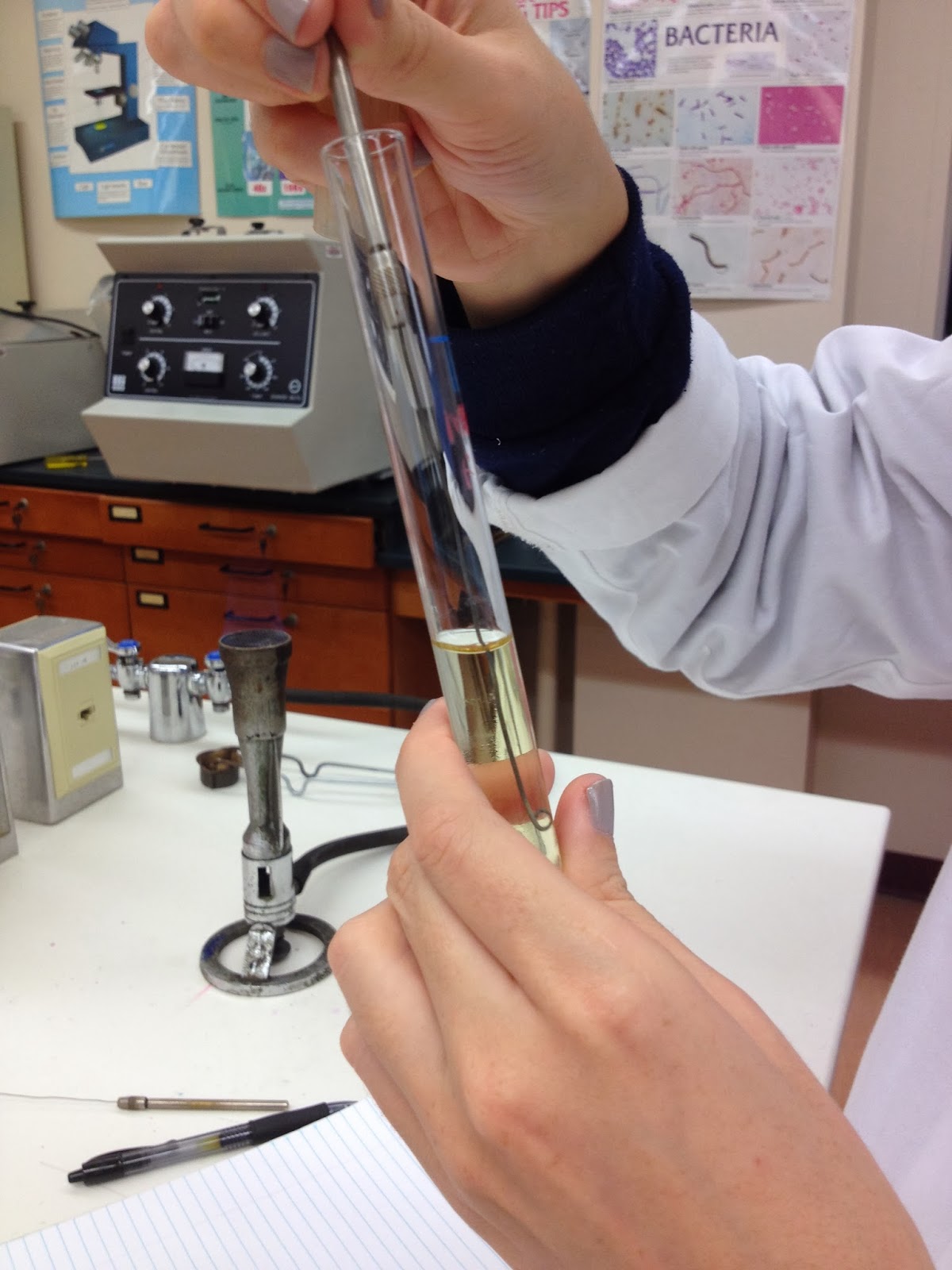
We first used the aseptic technique to inoculate the tryptone broth tube with a loopful of bacteria from our agar slant culture. 


Then we incubated the inoculated tube at 35 degrees Celsius for 2 days. 

When we came back after two days we added 5 drops of Kovac's reagent to the inoculated tube.


As you can see there is a darker yellow that has formed on top of the lighter yellow broth. This means that the test came out negative. Therefore, our bacteria are not able to split the amino acid tryptophan into indole and pyruvic acid.


Nitrate Reduction Test

The Nitrate Reduction test determines if our bacteria is able to reduce nitrate ions to either nitrite ions or nitrogen gas.

We first obtained a nitrate broth tube and used the aseptic technique to inoculate the nitrate broth tube with a loopful of bacteria from our agar slant culture.


We then incubated the inoculated tube at 35 degrees Celsius for 2 days.

After two days, we added 5 drops of reagent A (sulfanilic acid) and 5 drops of reagent B (dimethyl-alpha-naphthylamine) to our inoculated tube. We made sure to wear gloves when we added the nitrate reagents.


After one to two minutes, we did not see a color change to pink or red color which means that we now need to add a small amount of powdered zinc to the tube.


After about 10 minutes we saw a small color change to our broth. This means that our bacteria are not able to reduce nitrate ions to either nitrite ions or to nitrogen gas.

Methyl Red Test and Voges-Proskauer Test

The Methyl Red test determines the ability of some bacteria to ferment glucose due to mixed-acid fermentation. While the Voges-Proskauer test determines the ability of some bacteria to ferment glucose via butanediol fermentation.

First we used the aseptic technique to inoculate the MR-VP (methyl red/Voges-Proskauer) broth tube with a loopful of bacteria from our agar slant culture.


Then we incubated the inoculated tube at 35 degrees Celsius for two days. 

After two days we came back to lab and divided the MR-VP broth into two tubes so that we could use the broth to use for another test. For one of the tubes we added 6 drops of the methyl red to the tube. We then gently swirled the tube to mix the broth culture and the pH indicator

After we mixed the broth culture and the pH indicator we read the reaction immediately and we found that our test was positive.


Then we took the other tube of the MR-VP broth and added 15 drops of Barritt's reagent A (alpha-naphthol) and 5 drops of Barritt's reagnet B (KOH) to the tube.


We then tapped the bottom of the tube vigorously so that the oxygen in the air aerates the medium.

Afterwards we put the tube back in our rack for about 30 minutes. After 30 mines we read our results and found that our bacteria was positive which means that our bacteria used the butanediol fermentation pathway.


Litmus Milk Reactions

The litmus milk reactions allows us to see our bacteria's ability to utilize lactose, protein, and litmus in litmus milk. 

First we obtained a litmus milk tube and used the aseptic technique to inoculate the litmus milk tube with a loopful of bacteria from our agar slant culture.


We then incubated the inoculated tube at 35 degrees Celsius for two days.

When we came back to lab two days later we found that our tube showed acid curdling with litmus reduction. Unfortunately, we did not get a picture of it as we accidentally mixed the tube forming what is shown below.
 

Fat (Triglyceride) Hydrolysis Test

We used the fat hydrolysis test to determine whether our bacteria are able to digest a triglyceride, which is a type of lipid.

First we obtained a tributyrin agar plate and we used the aseptic technique to inoculate the tributyrin agar plate with a loopful of bacteria from our agar slant culture.


We then incubated the inoculated plate upside-down at 35 degrees Celsius for two days.

When we came back to lab two days later, we took out our plate from the incubator and examined the plate for a clear area around our bacteria growth (as indicated on the left). We did not see a clear area around our bacteria growth so this indicates that our bacteria are not able to digest a triglyceride.